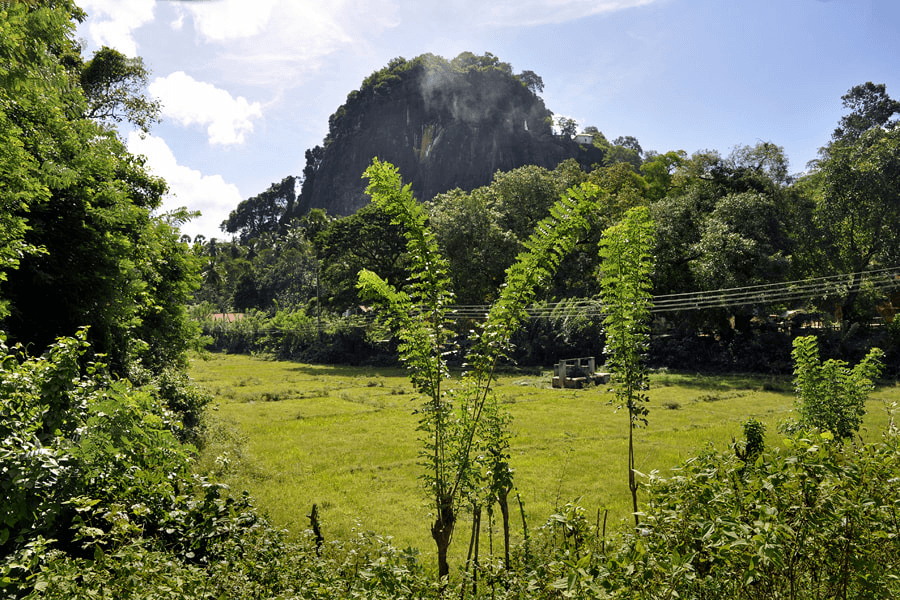
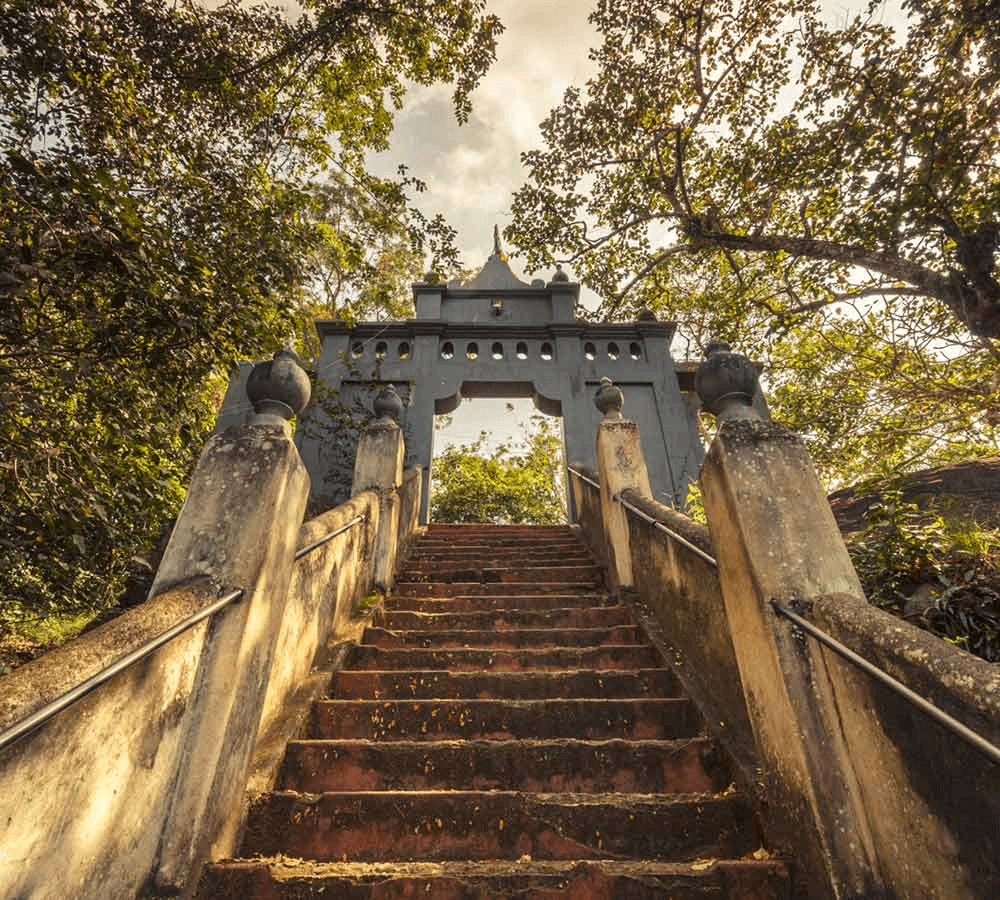
Mulkirigala rises roughly 200 metres out of the flat country north of Tangalle, with forest around its base and a Buddhist monastery built into its flanks. The Mulkirigala Rock Temple holds seven cave temples across five terraces, with painted walls and a reclining Buddha, reached by a stone stairway of around 500 steps. This guide covers what you will find on the way up, why historians know the place, and how to fit it into a day from Mirissa when the group includes both children and grandparents.
Five Terraces of Cave Temples
The temple is climbed in stages, with forest around the stairway for most of the way. Five terraces step up the side of the rock, joined by stone stairs, and the cave temples sit on them. Reveal’s guide to the site names the compounds as the Lower Temple Compound, Siyambalamaluwa, Bomaluwa, the Royal Temple Compound, and the Upper Temple Compound. The first terrace holds a Bodhi tree and a twin cave, Paduma Rahat Viharaya.
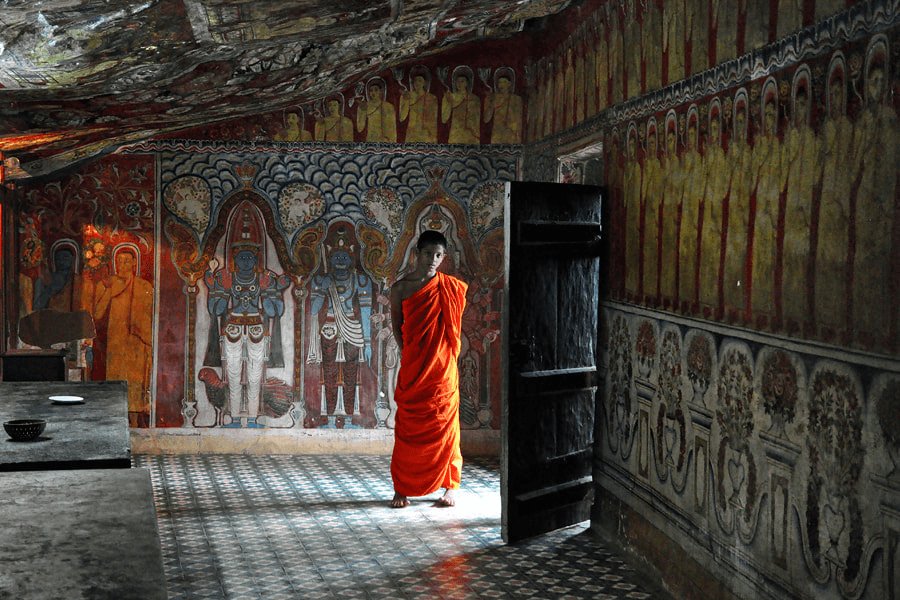
Inside the caves, colourful murals cover the walls and show scenes from the Buddha’s life, much of it Kandyan-era work. The shrines hold Buddha figures in several postures, including a reclining Buddha, and the complex also includes devalayas, the small shrines to deities found at many Sri Lankan temples. It remains a sacred place, and Reveal’s guide describes it as one of the most significant on the southern coast.
At the summit there is a pond, and the views run out over the forest and the flat plain around the rock.
The site appears under several names. Signs and maps may say Mulkirigala, Mulgirigala, or Mulkirigala Raja Maha Vihara, the last being its designation as a royal temple.
What the Mulkirigala Rock Temple Is Known For
The rock has a long record, and some of it is carved into the rock itself.
- Almost 2,000 years ago: the date usually given for the monastery’s beginnings.
- 6th or 7th century: inscriptions show the temple was in use.
- 9th or 10th century: an inscription found in the summit pond calls the monastery Muhundugiri Viharaya.
- 18th century: Dutch visitors call the rock Adam’s Berg, having mistaken it for Adam’s Peak.
- 1744 and 1807: the European writers Johann Wolfgang Heydt and James Cordiner describe the temple in print.
- 1820s: George Turnour finds the manuscripts described below.
The last entry is the reason the rock features in histories of Sri Lanka. Turnour, a British civil servant, found palm-leaf manuscripts in one of the caves, which housed a library. They contained the tika, a commentary on the Mahavamsa, the great chronicle of Sri Lanka. That commentary was the key to translating the chronicle from Pali, first into English and then into Sinhala, and it opened up the island’s recorded history from 543 BCE onwards. None of that is visible on the climb, but knowing it before you go gives the cave that held the library a reason to be noticed, and gives older children a story to carry up the steps.
Climbing It With Mixed Ages
The climb is around 500 stone steps, spread across the five terraces, which gives the group natural places to stop. Reveal’s guide describes wide views from the summit, so it helps to tell children there is something to reach at the top. Each terrace has cave shrines to look at, so slower walkers can take one shrine at a time, and anyone who turns back at a lower terrace has still seen cave temples. Letting the slowest walker set the pace keeps the group together, and it is worth checking the forecast first, since stone steps can be slippery after rain.
Before you go:
- Start in the morning or evening. Reveal’s guide recommends these hours to avoid the day’s heat and humidity.
- Cover shoulders and knees, as at any Buddhist temple.
- Wear shoes that slip off easily, since footwear comes off at the shrines.
- Carry water for the climb.
- Skip the flash near the murals, and never pose with your back to a Buddha statue.
Image suggestion: a family climbing the stone steps in the early morning, the forest on either side. Alt text: A family climbing the stone steps at Mulkirigala in the early morning.
Fitting It Into a Day From Mirissa
Mirissa’s own highlights are mostly on the water, so a day at the temple adds the south’s history to a stay otherwise spent by the sea. A day at the Mulkirigala Rock Temple is a full day out rather than a short detour, so an early start matters. Mirissa sits west of the rock, and the coast road east through Matara, Dikwella, and Tangalle gets you most of the way, with the final stretch inland. Starting early puts the climb in the cooler hours and leaves the coast road for the way back. A simple outline looks like this:
- Early morning: set off from Mirissa along the coast road.
- Morning: climb the terraces one at a time, taking the cooler hours.
- Midday: lunch on the coast.
- Afternoon: a stop at Hummanaya Blow Hole, then home to Mirissa.
Hummanaya Blow Hole at Dikwella makes an easy second stop on the way home, and lunch on the coast fills the gap between the two. The Rekawa Turtle Conservation Project, further east, centres on turtles coming ashore at night, so it suits a separate day rather than the end of this one.
A family villa in Mirissa suits a day like this, since the whole group can set off together and come back to the same place afterwards, whatever their ages or energy levels.
A Beachfront Base for the Way Back
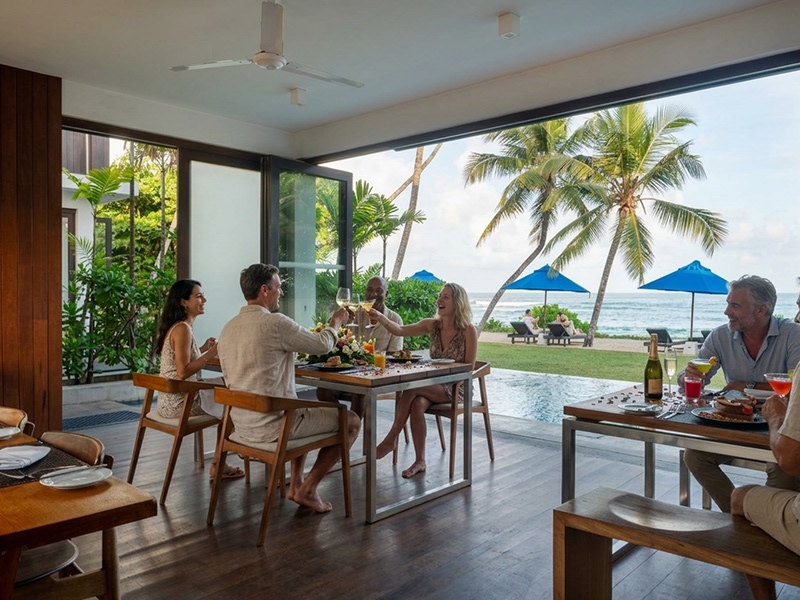
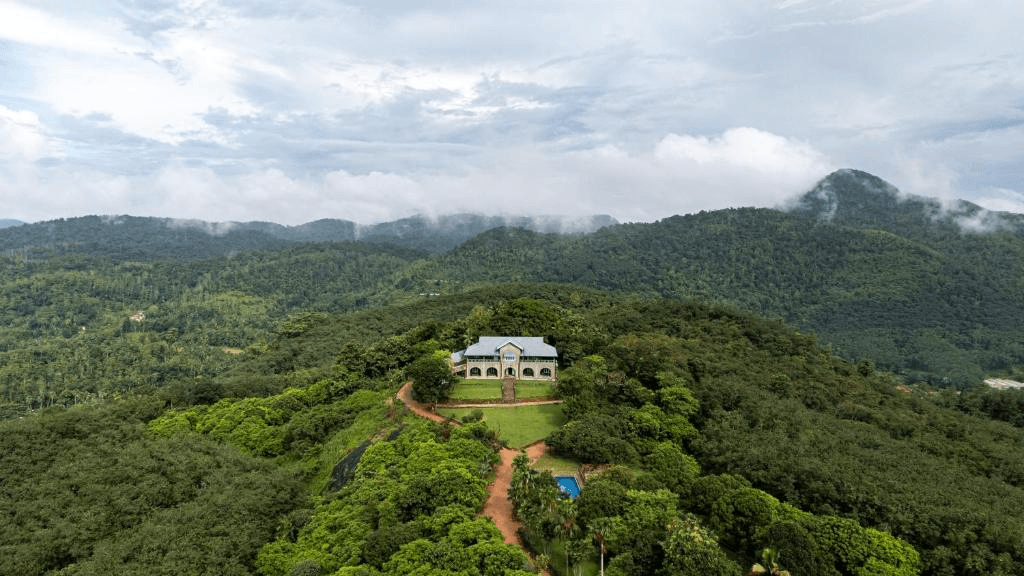
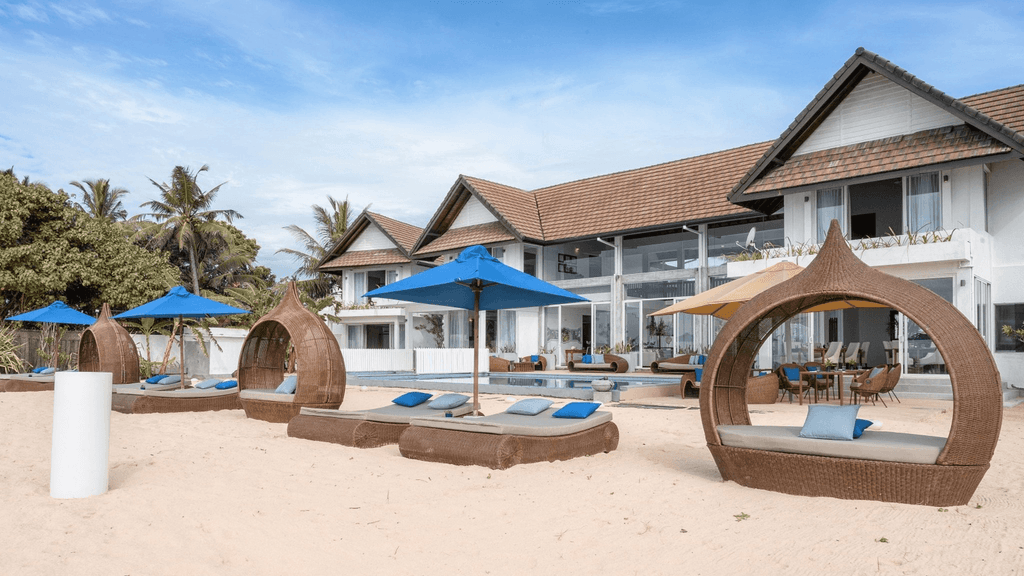
The Beach House is a six-bedroom beachfront villa in Mirissa, with ocean views, spacious living areas, a swimming pool, and a private lawn. It is set up for groups that span generations, which suits a trip like this one: everyone leaves from the same place, and the whole family returns to the same pool and lawn once the climb is done. The beach is right outside, so nobody has far to go to cool off. Guests who would rather skip the climb can spend the morning in the living areas or by the pool while the rest of the group goes up.
Explore the villa’s accommodation and current offers, or contact Reveal the Collection for help planning your stay. A climb through five terraces of cave shrines is easier to enjoy when everyone has somewhere comfortable to return to afterwards.